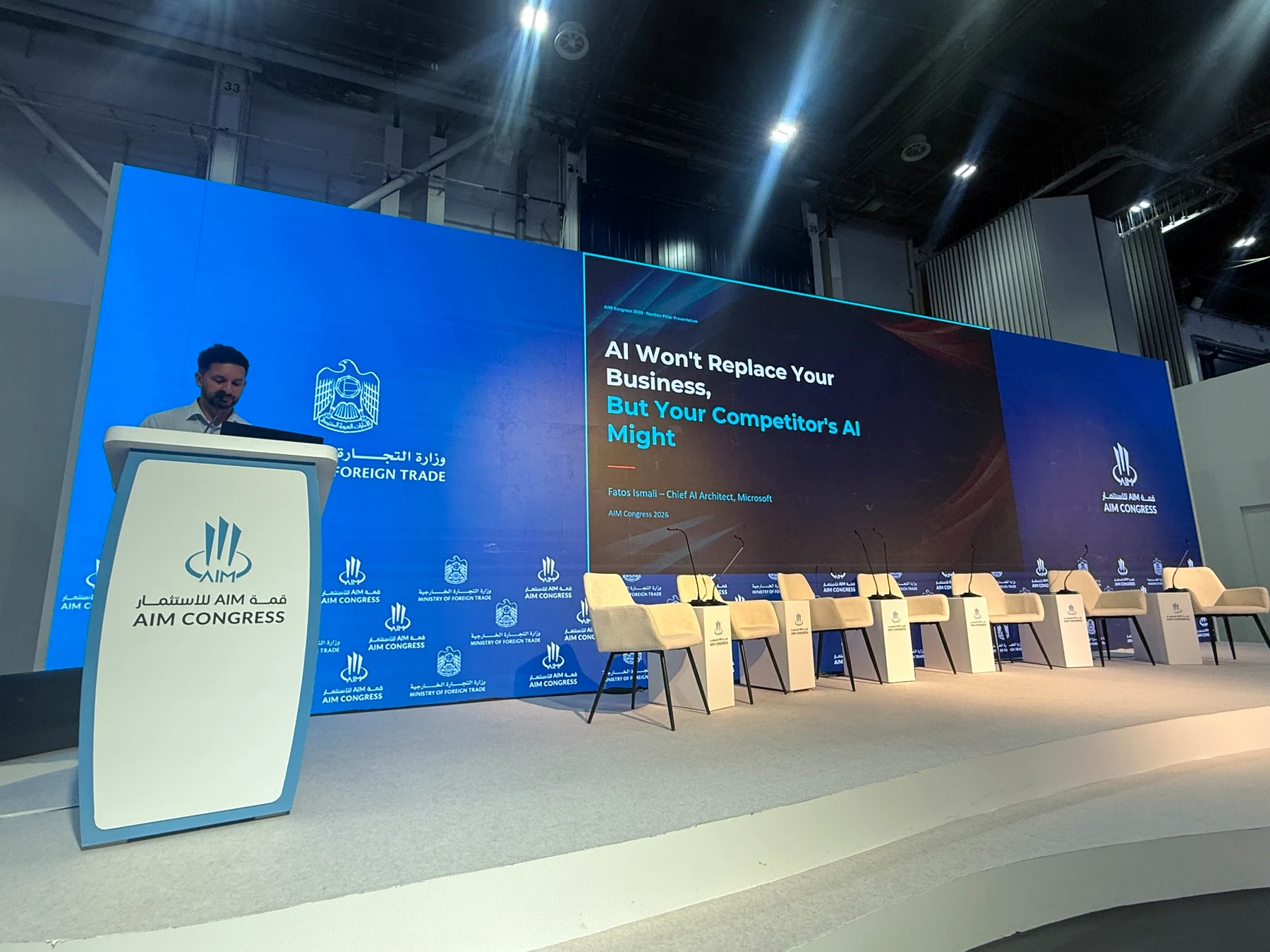
AI / AI Won't Replace Your Business, but Your Competitor's AI Might
AI Is Not the Advantage. Operationalising It Is.
Access to AI has become widespread. The harder question is whether an organisation can redesign work, govern the system and turn experimentation into measurable business value.
On this page
Deployment is becoming table stakes. The differentiator is whether an organisation can turn AI into a repeatable operating capability.
The experiment phase is ending
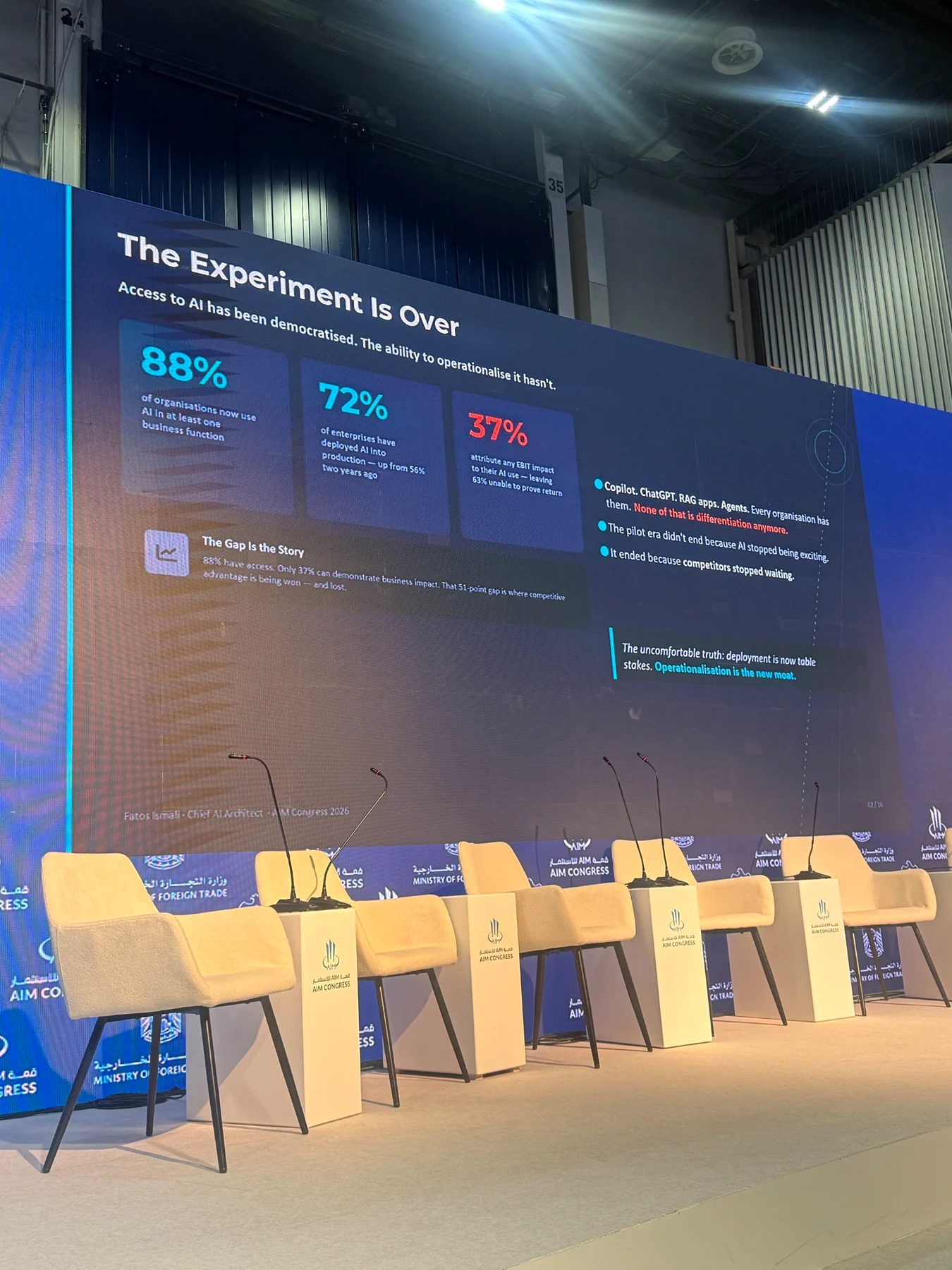
One of the clearest messages I heard at AIM Congress came from Microsoft's Chief AI Architect: access to AI is no longer the differentiator. The slide titled 'The Experiment Is Over' made the point with a striking gap. It showed 88 percent of organisations using AI in at least one business function and 72 percent having deployed AI into production, while only 37 percent attributed EBITDA impact to their AI use.
The implication is uncomfortable but useful. Buying tools, launching copilots and moving models into production are no longer sufficient evidence of transformation. If the technology does not change the economics, quality, speed or resilience of the work, the organisation has deployed AI without really operationalising it.
The session highlighted the gap between widespread AI adoption and measurable business impact.
Start with the outcome, not the tool
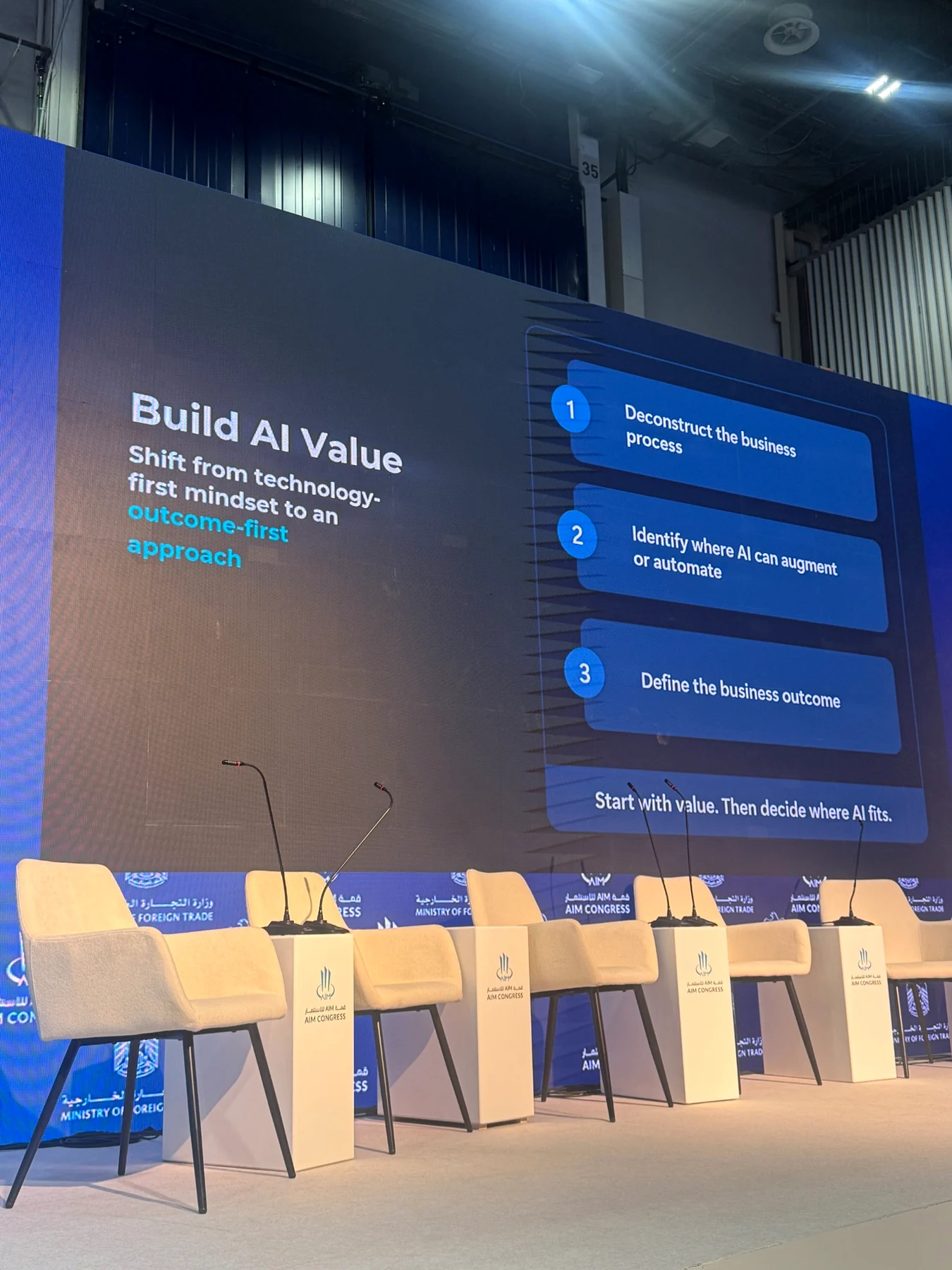
The session contrasted broad experimentation with deeper implementation. The more effective organisation does fewer things, takes them further and redesigns the process around the desired outcome. That is a fundamentally different starting point from asking, 'Where can we use AI?'
A slide summarised the approach simply: deconstruct the business process, identify where AI can augment or automate, and define the business outcome. The wording matters. AI is one design choice within the process - alongside automation, APIs, traditional software and human judgement - not the destination of the process.
The speaker's small-business example made the point even clearer: if the goal is something like improving attendee retention, the right answer may be a traditional recommendation algorithm rather than a large language model. Outcome-first design sometimes means choosing the less fashionable technology.
An outcome-first approach: deconstruct the business process, identify where AI can augment or automate, then define and measure the business outcome.
Concept model
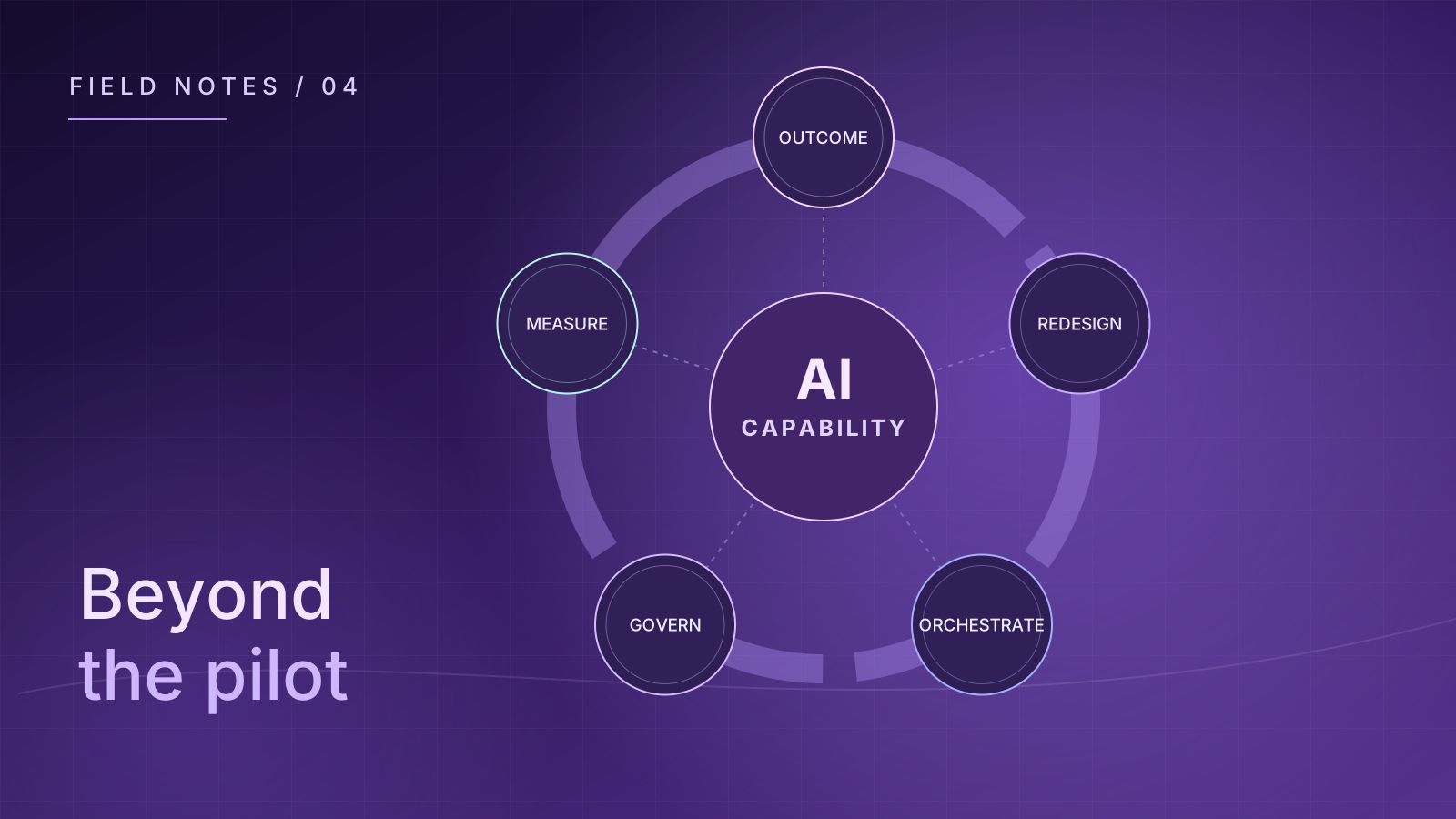
The AI operationalisation flywheel
Repeated value comes from redesigning operations, not collecting isolated pilots.
Select an idea to read how it fits. These are qualitative ideas, not data.
01 / 05
Outcome
Start with the business outcome that matters.
- 01 Outcome Start with the business outcome that matters.
- 02 Redesign Deconstruct work before selecting the tool.
- 03 Orchestrate Define human, agent and system responsibilities.
- 04 Govern Make safety, evaluation and cost visible in operations.
- 05 Improve Measure impact and reuse what works.
Agents change coordination, not just individual tasks
The agentic AI discussion pushed this further. The traditional workflow shown on screen was linear and fragmented: human, software, human, software, human - with hand-offs, delays and coordination cost. The emerging model is orchestrated and outcome-driven: a person can direct agents, tools and systems that execute work in parallel.
The session presented figures suggesting that 54 percent of enterprises had integrated AI agents into core operations by mid-2026, while 40 percent of large organisations were scaling agents, up from 27 percent the previous year. The important point is not simply faster adoption. It is that the unit of design is moving from the individual task to the end-to-end flow of work.
Production is not the destination
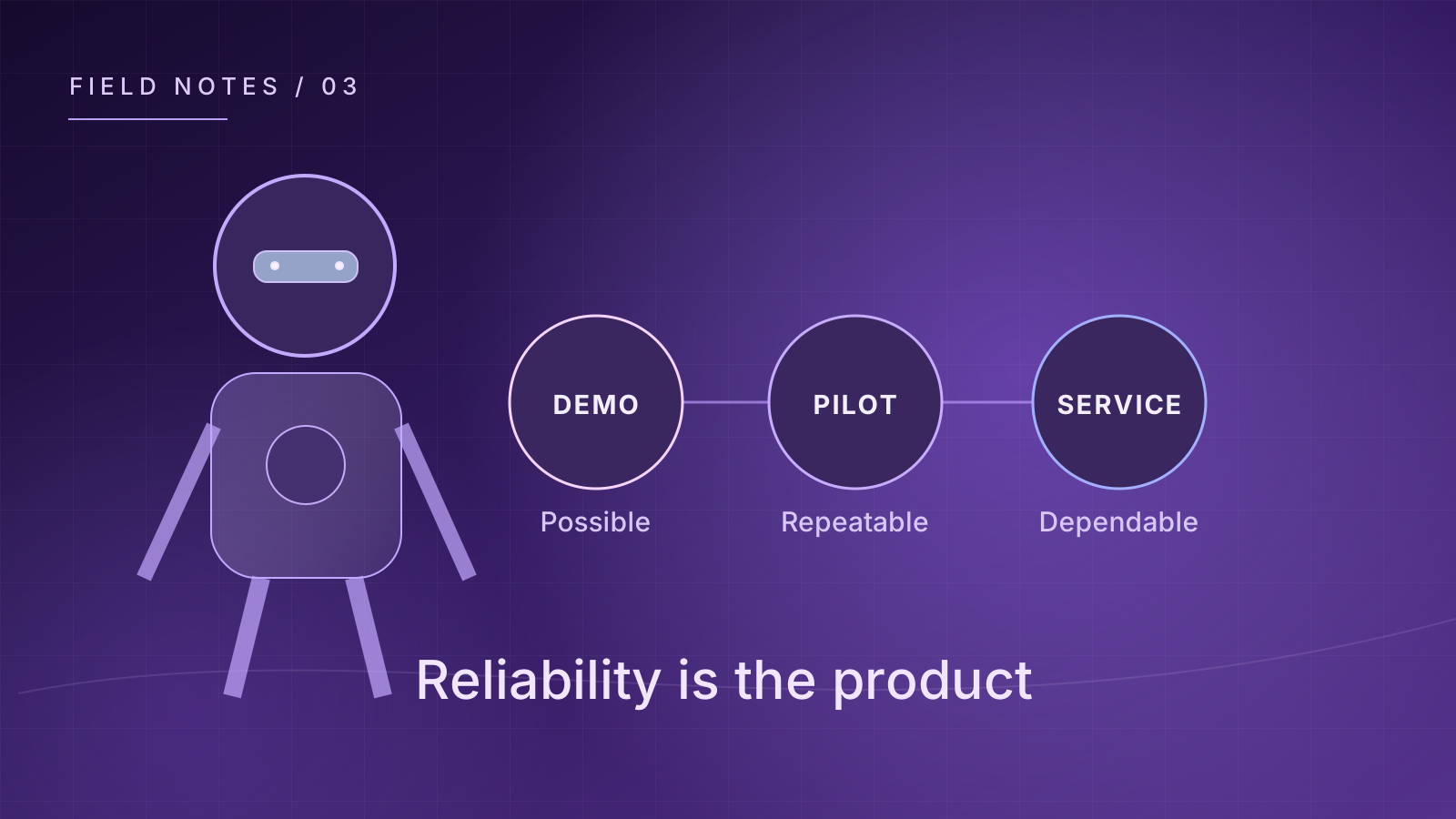
Another useful framework was the progression from proof of concept, to production, to platform. A proof of concept can be one use case, one team and one model with minimal governance. Production adds the controls needed for reliability: security, observability, evaluation, Responsible AI and cost management. A platform goes further, creating reusable components, shared infrastructure, shared knowledge and continuous governance.
This is where many AI programmes become stuck. The model itself may work, but the surrounding system is not mature enough to scale. Governance can become the bottleneck, not because governance is anti-innovation, but because trust, accountability and repeatability are necessary before AI can become part of core operations.
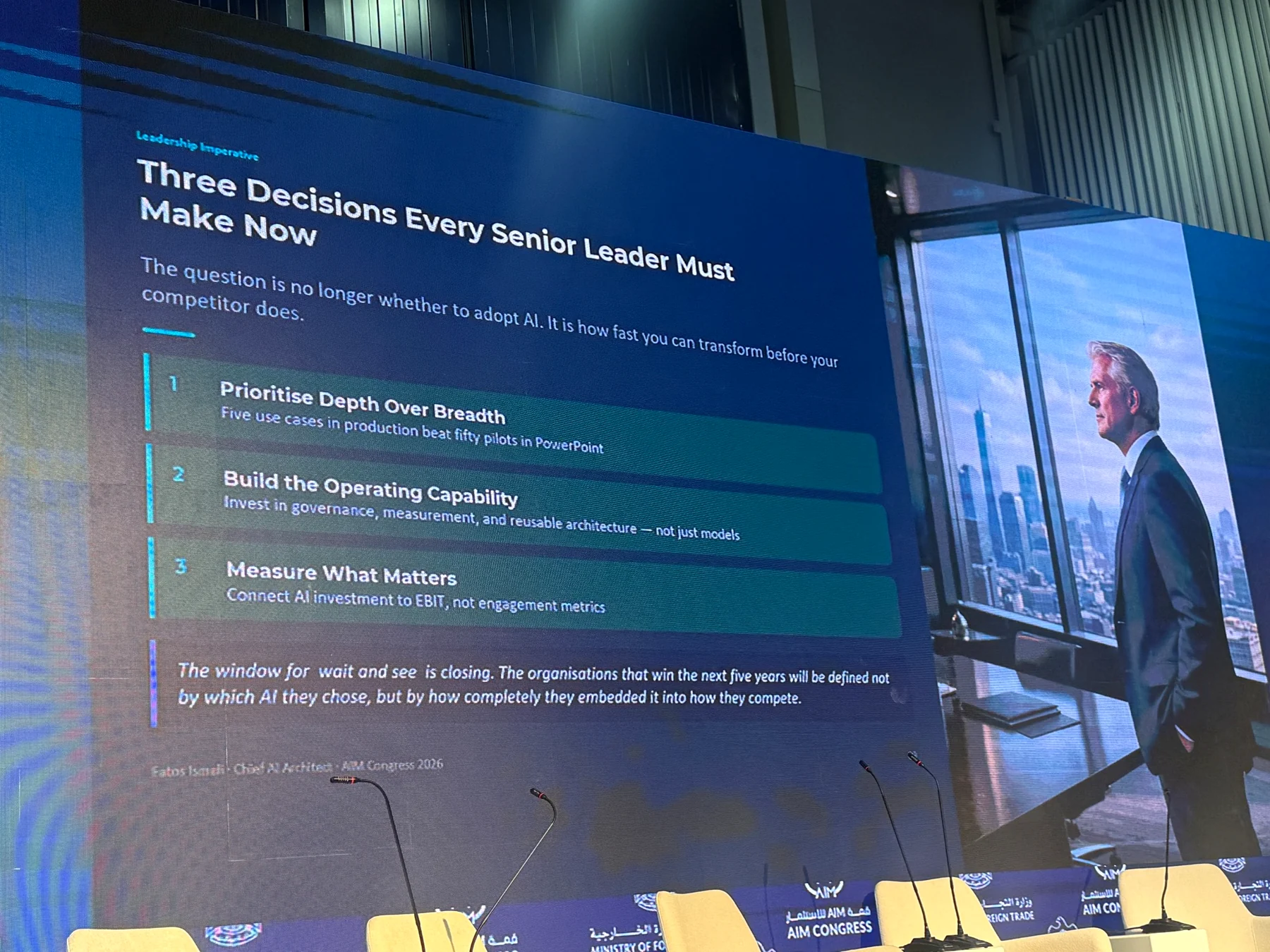
The leadership imperative presented in the session: prioritise depth, build operating capability and measure what matters.
The competitive race is organisational
The session's 'AI Transformation Flywheel' framed the real race as speed of conversion: experiment to capability, infrastructure, operating model and business outcome - then repeat the cycle faster. The competitor does not necessarily need a better model. They need to get better at embedding AI faster than you do.
That leads to three leadership decisions that were presented very clearly: prioritise depth over breadth; build the operating capability, including governance and reusable architecture; and measure what matters by connecting AI investment to business impact rather than engagement metrics.
What leaders should design now
For leaders, this moves AI out of the innovation lab and into operating-model design. The practical work is to choose a small number of high-value processes, redesign them end to end, define the role of people and agents, establish the controls that make the system trustworthy, and measure whether the new process actually performs better.
The organisations that win will not be those with the longest list of pilots. They will be those that learn how to convert AI into a dependable capability - and then repeat that conversion faster each time.
Five ideas worth carrying forward
- Prioritise a few use cases that can reach production and prove value.
- Redesign the process around the outcome instead of inserting AI into the old workflow.
- Build governance, security, evaluation and observability into the operating model.
- Move from isolated solutions toward reusable AI platforms and shared capabilities.
- Measure business impact - not usage, tokens or novelty.