FUTURE ECONOMIES / Building the World's Most Valuable Ecosystems - Digital Economy 4 Years from Now
Digital Ecosystems Are Built on Conviction, Not Just Infrastructure
The most valuable innovation ecosystems combine belief, early capital, founder density and physical infrastructure - and they solve problems that matter locally.
On this page
An ecosystem does not become credible after success appears. It becomes credible when belief, capital and infrastructure arrive early enough to make success possible.
The ecosystem conversation often starts too late
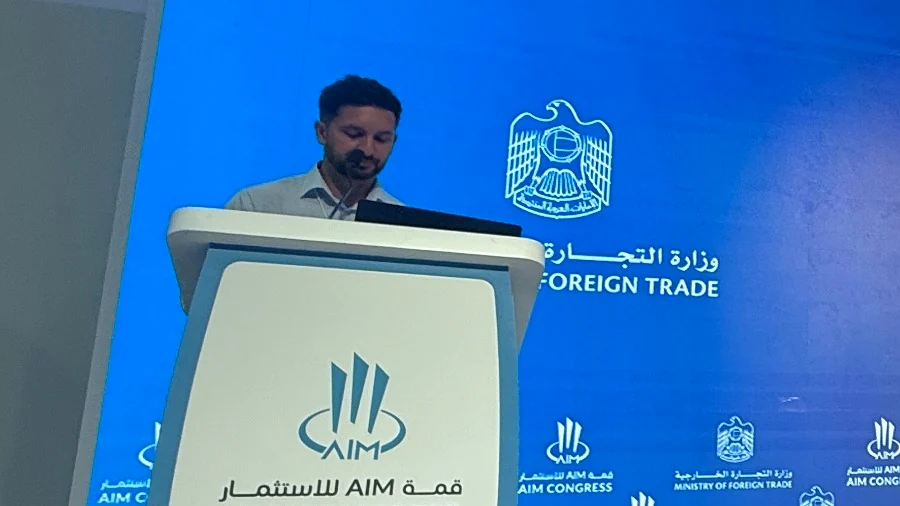
When people talk about building a technology ecosystem, the conversation often jumps straight to accelerators, funding announcements, innovation districts or flagship infrastructure. At AIM Congress 2026, the session on building the world's most valuable ecosystems challenged that sequence. The first ingredient discussed was not technology at all. It was belief.
One speaker argued that a young founder from any background should be treated as having the same potential to build a major technology company as a founder in Silicon Valley. In many emerging markets, belief tends to arrive after success. The session made the opposite case: belief has to precede it. That is more than an inspirational point. It shapes who receives attention, who is invited into networks, who gets a first customer and who is considered investable before there is proof.
The first million matters disproportionately
The panel placed particular emphasis on the speed and availability of the first USD 1 million of investment. Later-stage capital matters, but early capital changes a founder's trajectory when the company is still fragile. If that money is slow or inaccessible, ambitious founders begin to design their future around leaving the market rather than building in it.
That creates a useful distinction between an ecosystem that celebrates entrepreneurship and one that actually reduces the friction of becoming an entrepreneur. Capital is part of the answer, but the session also highlighted the importance of proximity: residencies or accelerators that bring founders together for four to twelve months, allowing ideas, talent and networks to compound through repeated interaction.
Concept model
Five conditions that reinforce an innovation ecosystem
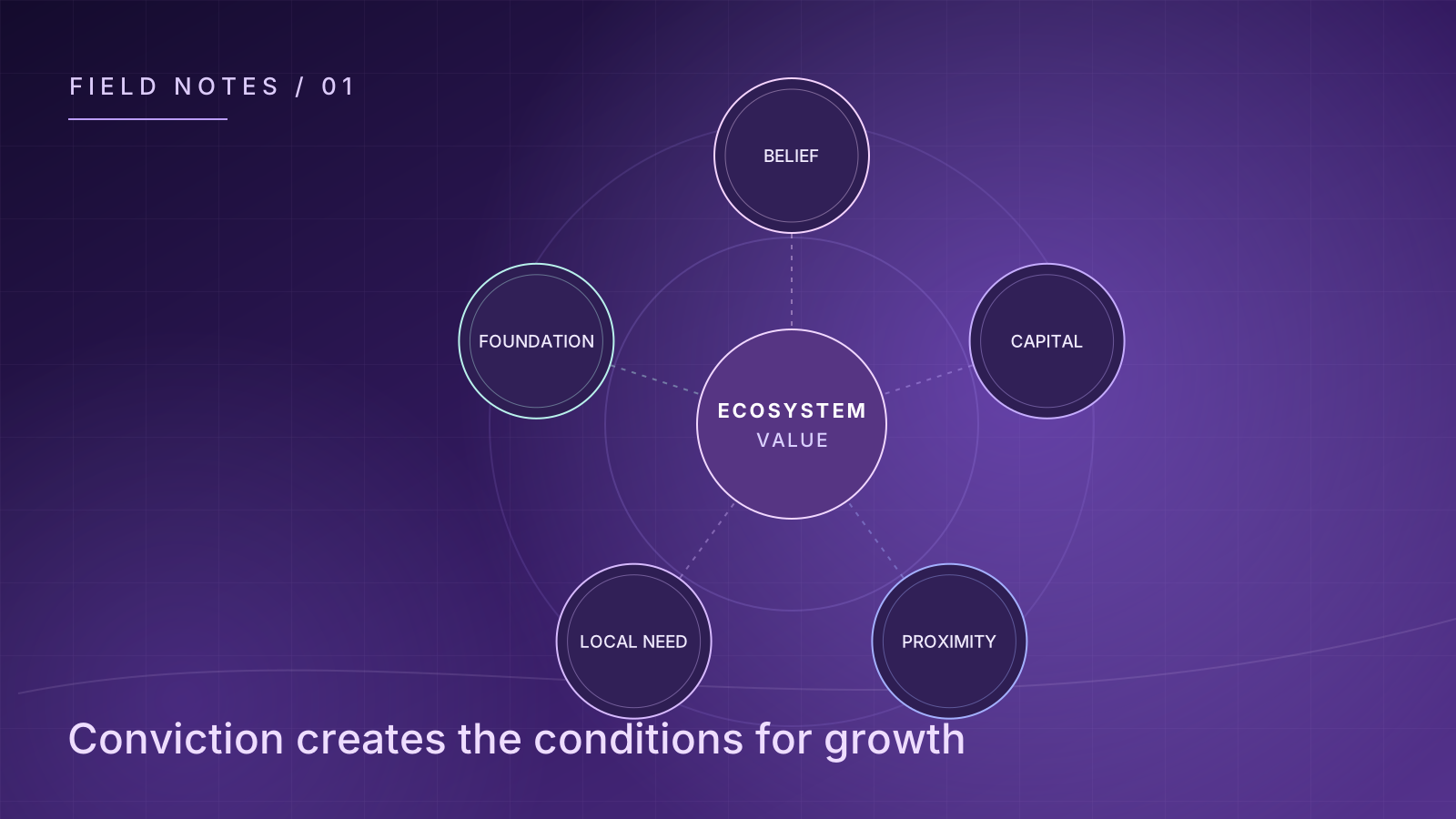
Ecosystems create value when their foundations reinforce each other, rather than appearing one by one.
Select an idea to read how it fits. These are qualitative ideas, not data.
01 / 05
Belief
Take local founder potential seriously before there is visible success.
- 01 Belief Take local founder potential seriously before there is visible success.
- 02 Early capital Reduce the friction of the first meaningful investment.
- 03 Proximity Create spaces where founders, mentors and partners interact repeatedly.
- 04 Local problems Use regional needs as a source of differentiated innovation.
- 05 Infrastructure Make the physical environment ready for digital growth.
Solve local problems, not imported ones
Another point that stayed with me was the emphasis on solving problems that are real in the region. The most valuable companies do not have to begin by copying a model that succeeded somewhere else. They can begin with the problems that local communities, governments and industries already feel intensely - whether related to resilience, mobility, public services or other regional challenges.
This matters because locally rooted problems create a stronger reason for an ecosystem to exist. They also create a natural test bed. The combination of local need, founder proximity and early capital can generate solutions that are globally relevant precisely because they were built against demanding real-world conditions.
Digital economies still need a physical foundation
The second half of the discussion brought the argument back to infrastructure. A digital economy cannot scale if the physical environment does not keep pace. Housing, connectivity, digitally enabled buildings and the wider urban environment all influence whether talent can live, work and collaborate effectively.
The panel also linked digitisation to trust. One example was the use of a customer app for project updates and invoicing, alongside digitised payments for sales partners, to give investors greater transparency into delivery. The broader lesson is that digital infrastructure is not only about convenience; it can become part of the trust architecture around an ecosystem.
The phrase that stayed with me was that the physical world has to move with the same 'digital discipline' as the technology. Housing, connectivity and digitally enabled buildings cannot be an afterthought if the goal is to attract talent, capital and long-term growth.

What I took away
The strongest ecosystems are not built through a single policy, fund or innovation hub. They are built when several conditions reinforce one another: credible belief in local talent, fast early-stage capital, spaces that create founder density, a bias toward meaningful local problems, and infrastructure that is ready for digital growth.
For leaders designing innovation programmes, the practical question is therefore not simply, 'What should we build?' It is, 'What friction are we removing for the people we want to succeed?' That shift moves the conversation from ecosystem branding to ecosystem performance.
Five ideas worth carrying forward
- Back local potential before there is visible proof.
- Reduce the time and friction around first-stage capital.
- Create repeated physical proximity between founders, mentors and partners.
- Use regional problems as a source of differentiated innovation.
- Design physical and digital infrastructure as one system.