MASTERCLASS / Smart Content, Scalable Impact: Omnichannel Strategies for Creators and Brands
Create Once, Distribute Everywhere: Why Content Strategy Is an Operating System
A content calendar keeps you busy. A content system turns one strong idea into a repeatable format, distributes it deliberately and measures whether people actually care.
On this page
- Brands are becoming media companies
- Create once, distribute everywhere
- Formats scale better than personalities
- Your archive may already contain your next campaign
- Serve the audience, not the ego
- Measure depth, not just reach
- Where AI fits - and where it does not
- What I took away
- Five ideas worth carrying forward
A content calendar is an activity plan. A content strategy is a system for turning ideas into formats, distribution and audience value.
Brands are becoming media companies
The masterclass on smart content and scalable impact began with a premise that is easy to underestimate: brands no longer simply buy access to audiences; they increasingly operate as media companies themselves. Every social channel is a publishing surface, and every organisation has to decide what it wants to be known for, how consistently it can show up and why an audience should return.
That is a different challenge from producing more posts. It requires a system that can generate, package and distribute ideas without losing their meaning.
Create once, distribute everywhere
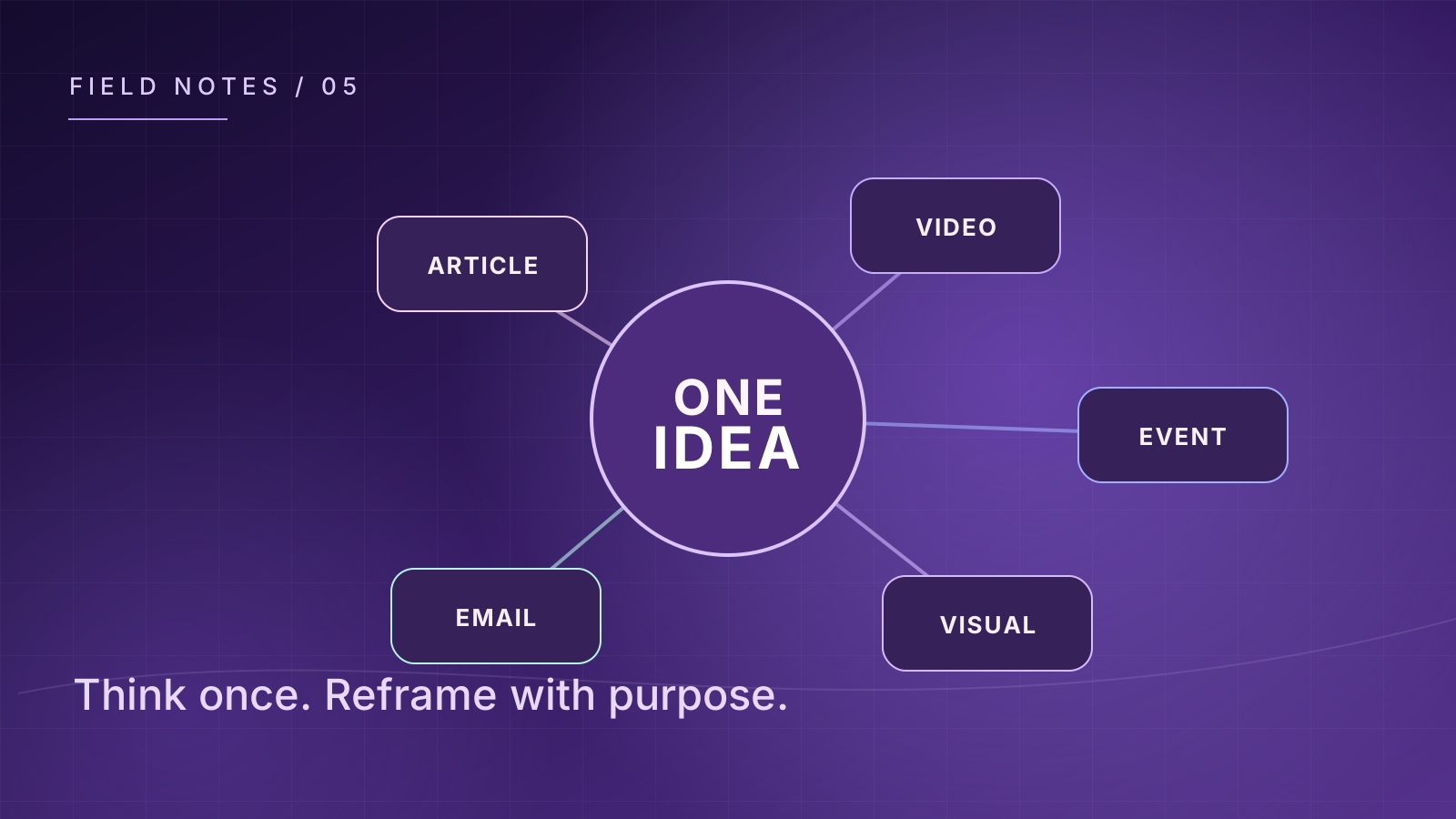
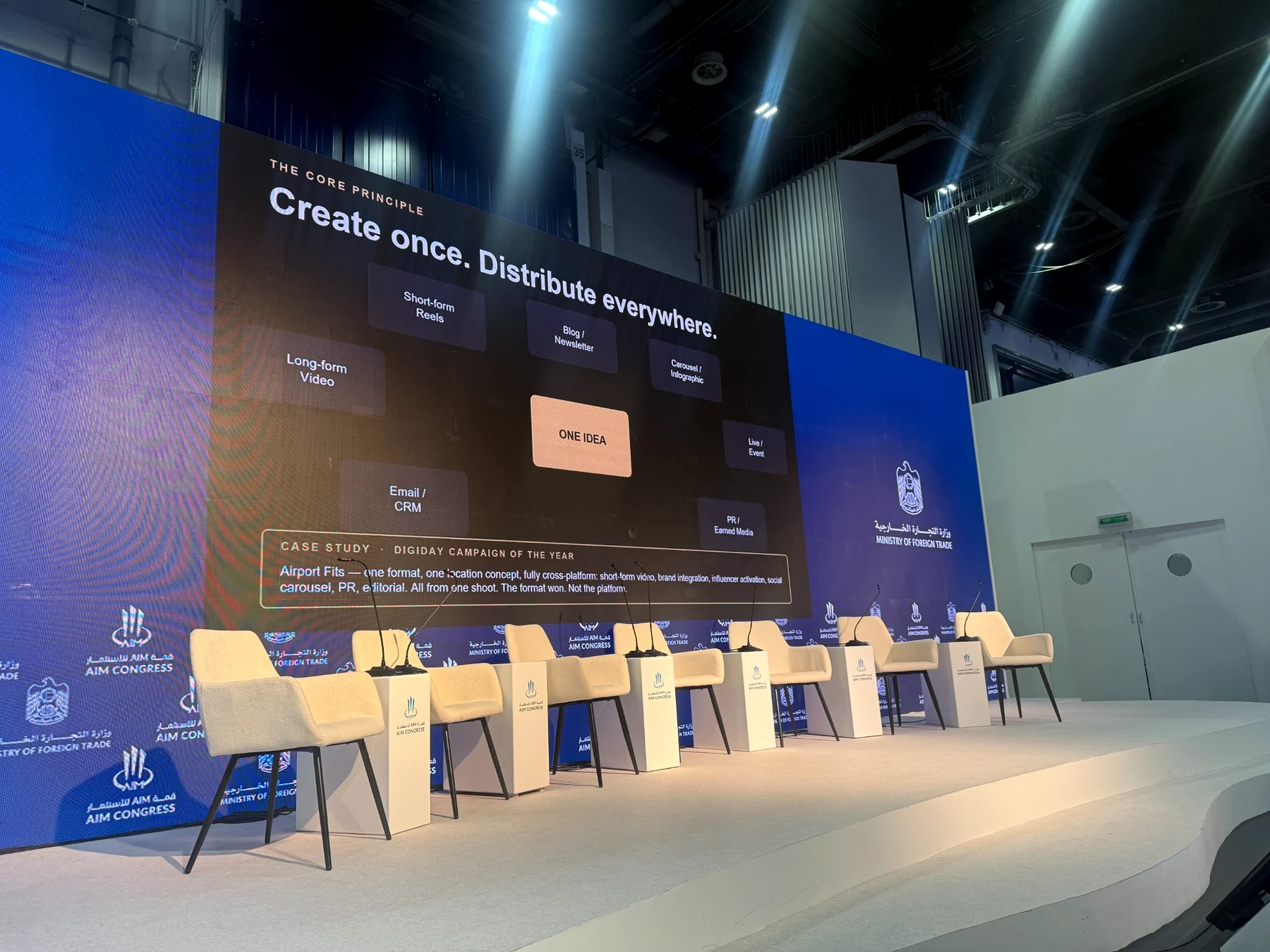
The strongest slide in the session reduced that system to one principle: 'Create once. Distribute everywhere.' One idea sat in the centre, surrounded by long-form video, short-form reels, a blog or newsletter, carousels or infographics, live events, PR and earned media, and email or CRM.
The value of the model is not that every idea should appear identically on every platform. It is that the expensive part - the thinking, research, point of view or original access - should be designed for reuse from the beginning. Distribution is part of the creative brief, not something considered after the content is finished.
Concept model
One strong idea, many useful formats
Repurpose the thinking, not merely the finished asset.
Select an idea to read how it fits. These are qualitative ideas, not data.
01 / 05
Core idea
Begin with original insight and an audience need.
- 01 Core idea Begin with original insight and an audience need.
- 02 Long form Develop the argument in an article or briefing.
- 03 Visual Create accessible diagrams or carousels.
- 04 Conversation Adapt the idea for video, events or interviews.
- 05 Learn Measure depth and iterate the format.
Formats scale better than personalities
The speaker also challenged the creator-led model by arguing for formats that can outlive an individual creator. A strong format creates recognisable structure, repeatability and lower risk for a brand. The example used was the durability of television formats that remain valuable even as individual talent changes.
For organisations, this is a useful lens for thought leadership. Instead of relying on occasional hero pieces, create repeatable formats: a quarterly insight series, a recurring interview, a visual diagnostic, a field note, a short executive briefing. The format becomes an asset because the audience learns what to expect.
Your archive may already contain your next campaign
Another practical point was to look backward before creating something new. The session used examples of brands and media companies repurposing older ideas and programmes to generate new value. Most organisations already have a significant archive: case studies, presentations, internal research, speeches, event recordings, client questions and lessons learned.
The missed opportunity is often not lack of content. It is lack of a mechanism for finding the strongest ideas, updating them and translating them into the formats people consume now.

Serve the audience, not the ego
Another useful challenge was to reverse the usual direction of content planning. Instead of starting with what the brand wants to say, start with what the audience needs, using data, surveys and feedback to shape the idea and format. Distribution works better when the content is designed around a real audience need rather than internal publishing pressure.
Measure depth, not just reach
The session was equally clear on measurement. Impressions and follower counts can be comforting because they are visible, but they do not necessarily reveal whether the audience found the content useful. Better signals include how long people engage, what they do next, whether they return and whether they choose to join a community you can reach directly.
That also explains the emphasis on building an owned community rather than relying entirely on rented social platforms. Distribution matters, but durable audience relationships matter more.
Where AI fits - and where it does not
AI was positioned as a tool inside the workflow rather than the primary creator. It can sharpen ideas, help adapt content and make distribution more efficient. But the session argued that human-created and live content still performs strongly because people value authentic interaction, judgement and experience.
That is an important distinction in a market filling rapidly with synthetic content. AI can reduce production friction, but it does not remove the need for a point of view. If anything, easier production makes original thinking more valuable.
What I took away
For professionals building a visible point of view, the lesson is to stop treating content as a stream of isolated posts. Start with a small number of ideas you genuinely own. Turn them into repeatable formats. Design the distribution system before publishing. Use the archive intelligently. Then measure whether the work creates depth, return and action.
The goal is not to publish everywhere. It is to make each strong idea work harder.
Five ideas worth carrying forward
- Start with one strong idea grounded in audience need, then design the distribution system around it.
- Build repeatable formats rather than isolated posts.
- Mine existing case studies, talks and archives before starting from zero.
- Measure return, action and depth - not only reach.
- Use AI to sharpen and scale human thinking, not replace the point of view.